.png)
The Server Nobody Wants to Touch
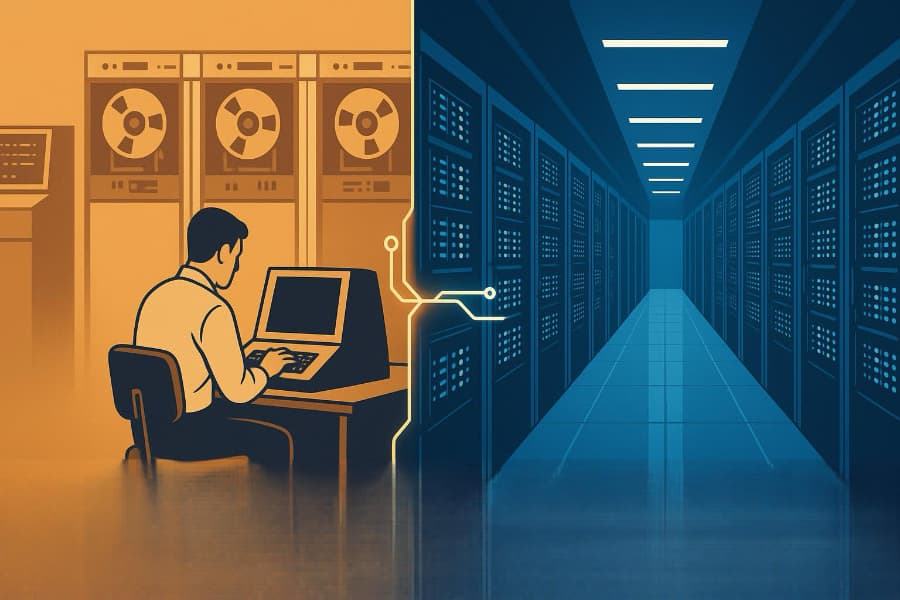
Every shop has one. The server nobody wants to touch. It's running an operating system that went end-of-life while you still had hair, it hosts an application whose vendor stopped returning calls in 2016, and the last person who understood it took early retirement. So it sits there, unpatched, humming along. It has become a load-bearing wall in a house no one is allowed to renovate.
How you end up here
This is never a planned situation. Nobody writes "let this box rot for a decade" into an application lifecycle. It happens because the application can't be moved to a modern OS, because patch windows never materialize, because the app is locked to antiquated hardware, or because the last time the box was rebooted it took a team of engineers 12 hours to bring it back up. Once someone has been burned by a patch and reboot, that box quietly falls out of the patch cycle. And it never gets back in.
That's where the illusion starts: the idea that it's safer to let the system sit unpatched. That one AIX LPAR with hundreds of days of uptime. That Brocade switch that hasn't seen service in 8 years, so the latest Fabric OS isn't even available to deploy. The old Solaris SPARC server with drives that might not spin back up after a powerdown. Things build up over time in an enterprise. It's nobody's fault — these situations are genuinely difficult to control, and these systems are genuinely difficult to patch and maintain.
The illusion holds until it doesn't
Even before the rise of AI, attackers were scanning for vulnerabilities in exposed systems and networks. Large enterprises carry a large risk profile and make obvious targets. But just as often, it's the smaller shops — schools, hospitals, small businesses — that get hit. And the loss isn't just revenue while you're down. It's the man hours poured into recovery, the potential lawsuits if PII or PHI walks out the door, and the potential loss of data outright if ransomware gets in.
AI has made this worse. Point an agent at a system, tell it to deploy a swarm of tests, and see what breaks. Zero days and exploits are surfacing faster and more often because you no longer need to be adept at finding them — AI can fabricate and run them in parallel. It has never been easier to end up on the wrong end of a bad actor.
Buying time
There are ways to mitigate some of these attack vectors.
An airlocked environment works for hardware that can't be patched — storage arrays, fibre channel switches, anything where the control plane can be isolated to dedicated networks. But an airlock won't work for a core webapp that's been hard-coded to a certain version of glibc. In some of those cases, a load balancer like an F5 can help. The F5 puts a layer between the core apps and the networks that need to reach them, and those apps can then be airlocked in their own isolated subnet — with the F5 and a few select jump boxes as the only way in.
For the systems you're struggling to get off of, long-term third-party support may be viable. On the hardware side, companies like Park Place Technologies offer different levels of support for gear the OEM has walked away from. On the Linux side, a handful of companies will keep releasing patches for critical CVEs long after upstream stops — CIQ Bridge (for CentOS) and TuxCare both do this. The support is out there, but there's no denying it becomes another line item in the budget.
For aging hardware itself, though, there's really no mitigation that prevents failure. Sure, you can usually find secondhand replacement parts on eBay (been there, done that), but your mileage may vary. Sometimes a vendor will do Time and Materials at Best Effort to keep a system limping along, but often the fix literally costs more than the replacement (also been there, done that). Third-party support reduces the pain of suddenly having to source hardware, but it doesn't stop the failure from happening.
The only real fix
Everything above buys time. It does not fix the core issue. The only real resolution for a legacy system is to get off it.
The way you do that without a horror story is the way you'd approach any high-stakes migration: architecture-first, one workload at a time, with a tested rollback at every step. For servers, cloning and snapshotting let you test outside of prod. Get the duplicate built, isolate it in its own subnet, perform the patching and testing, develop a working plan — then, before touching prod, take another clone or backup so you can revert to a known-working system. Depending on the environment, a lot of that test suite can be automated. Understand the dependencies before you move, validate on a twin, and keep the snapshot safety net underneath the whole thing. Rip-and-replace is how you generate the exact outage you were trying to avoid.
That server nobody will touch? It stays untouchable exactly as long as touching it feels like a gamble. Make patching reversible and testable, and it becomes just another Tuesday. For the systems you're afraid of, you don't need more courage — you need a safety net.
Building the safety net
That safety net is what we do at StoneCreek. We've spent years in environments exactly like the ones described above — the AIX LPARs nobody reboots, the storage fabrics running firmware from another decade, the apps welded to hardware the vendor forgot. We can help you map the dependencies, build and isolate the test twins, put the rollback plan in place, and work the migration one workload at a time so the untouchable box finally gets touched — without the sev 1. And for the systems that genuinely can't move yet, we can help you set up the airlocks, the third-party support, and the mitigations that keep them defensible in the meantime.
If there's a server in your shop that everyone walks past a little faster, reach out. We've been there. We can help.