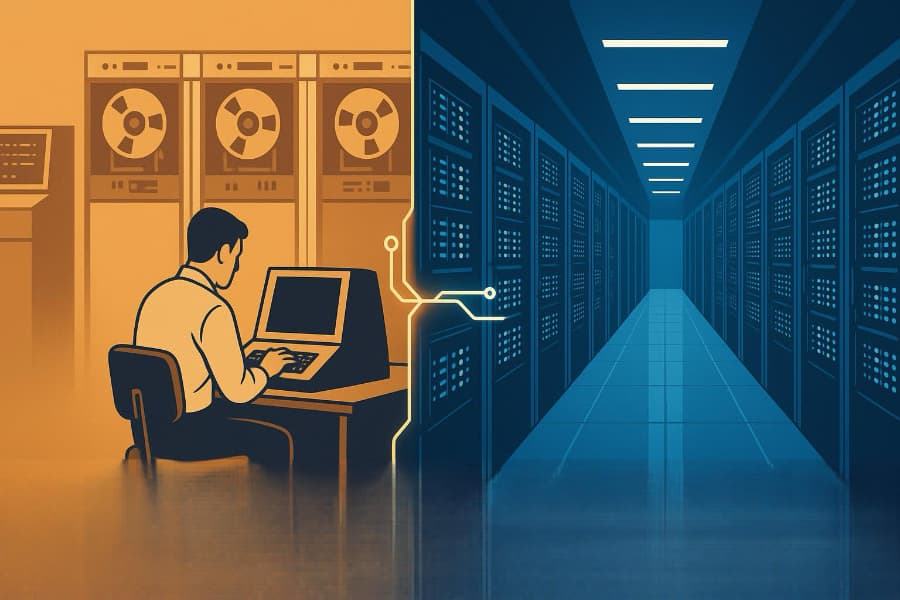
Beyond Backup: Why VM2020's CyberVR Is the Vendor-Agnostic Recovery Platform Your Environment Actually Needs
Every storage team eventually hits the same wall. You've got immutable snapshots sitting on the array, your replication topology looks solid, and your RPOs look great on paper — but the moment you actually need to use that data for recovery, testing, or validation, the process turns into a manual, multi-team scramble. Spin up VMs, reattach storage, rebuild networking, hope nothing was missed. That gap between "we have a snapshot" and "we have a working environment" is exactly the problem VM2020 set out to solve.
CyberVR was developed to address the above needs — and one of its most important qualities is that it doesn't care what storage vendor's logo is on your array.
What Makes CyberVR Different: It Works Where You Already Are
Very few enterprise environments are single vendor anymore, and all the OEMs do some type of immutable snapshots these days, most of them do a pretty good job of it. What they don't do well is recovery. Don't get me wrong they will all recover a snapshot to the original, or allow you to mount a snapshot to another machine. But they all need some type of orchestration that ties the snapshots back to an application or consistency group. It generally takes multiple teams, app teams, VM teams, storage teams, etc. This is where CyberVR really shines, and unlike some tools, Zerto for instance, that lock you into a vendor, CyberVR doesn't ask you to adopt a new storage stack or replace existing data protection tooling. CyberVR is designed to sit on top of whatever immutable snapshots your infrastructure already produces. It integrates natively with storage arrays and orchestrates the layers above them: hypervisor, network, and compute — automatically.
That philosophy shows up in the partner list. VM2020 has established formal technology alliances across the enterprise IT ecosystem:
- Hitachi Vantara — Deep integration with Ops Center Protector immutable snapshots and VSP array management for the fastest ransomware recovery validated at scale.
- HPE (SimpliVity) — A Silver Member of the HPE Technology Partner Program, CyberVR pairs with HPE's hyperconverged infrastructure to deliver sandbox environments without additional hardware.
- Dell — Supported as part of VM2020's broader storage ecosystem.
- Nutanix — Combines CyberVR's patent-pending Digital Twins with Nutanix full-stack APIs and snapshots for cyber resilience and DevOps on hyperconverged platforms.
- IBM — A formal IBM Technology Partner, CyberVR extends thin digital twin technology to IBM Power workloads including AIX, Linux, and IBM i — the only scaled, automated Isolated Recovery Environment (IRE) to do so.
- Rubrik — A dedicated CyberVR/Rubrik solution brief covers joint use cases for ransomware recovery and sandbox-based vulnerability remediation.
- AWS and Google Cloud — Technology alliances for hybrid and cloud-connected environments.
This isn't a case of one vendor building a closed tool and badging it as "open." VM2020 has put in the partnership work across the industry's major platforms so that whatever combination of infrastructure a customer runs, CyberVR can meet them there.
The Core Technology: Thin Digital Twins
The engine underneath all of this is VM2020's thin digital twin concept. CyberVR twins map directly to zero-footprint snapshots or clones already residing on the storage array, then tie those to the hypervisor and network layers — creating a fully functional, production-equivalent environment in minutes.
The heavy lifting that makes this possible was years of optimizing how to parallelize storage operations and stitch together all three infrastructure silos simultaneously. The result is that CyberVR can reconstruct thousands of VMs and their interconnections — and deliver them to a team as a live, isolated sandbox — in the time it used to take just to locate the right snapshot.
The Core Benefits
Dramatically faster recovery. Because CyberVR builds environments directly from array snapshots rather than rehydrating data from a backup target, recovery times that used to span days can come down to hours or minutes. Organizations using CyberVR alongside Hitachi Ops Center Protector have recovered well over 1,500 VMs and over 100TB of data in under an hour — the kind of result that changes how an auditor or CISO evaluates their ransomware exposure.
Realistic, isolated testing without touching production. How many times have we heard the horror stories of failed patch operations bringing down production, or a security team bringing down production while testing for vulnerabilities? Patch validation, vulnerability remediation, application upgrades, and "what-if" analysis can all run inside an isolated, full-scale replica of the production environment with zero risk to live systems. Teams that dread patch weekends can walk in with validated results instead of crossed fingers. Healthcare customers have specifically called out the ability to test across siloed applications — something they never thought was possible — without fear of cascading failures.
A genuine answer to ransomware, not just a backup copy. When an attack hits, the only real options are paying the ransom or reverting to a known-good point in time. CyberVR automates the second path: it detects which VMs are protected, reconstructs them along with their interconnection fabric, and brings up an isolated recovery environment that can be hardened and validated before anything touches production again. That automation increasingly runs proactively, too — simulating attacks, walking through containment procedures, and building the team muscle memory that makes the difference when a real incident occurs. If you pair CyberVR with Index Engines and CyberSense, the system can not only activate the data, it can determine which devices have been affected by ransomware and work around those devices.
Bare metal and IBM Power, not just virtual. Not everything runs in a VM, and CyberVR accounts for that. Physical x86 servers can be recovered as virtual machines within the CyberVR environment, triaged and hardened, then moved back to bare metal. IBM Power (AIX, Linux, IBM i) receives the same thin digital twin treatment through the IBM technical alliance — making CyberVR the only platform of its kind that spans both x86 and Power architectures in a single automated IRE workflow.
Compliance and audit readiness. For organizations facing operational resilience mandates — DORA in the EU being the most immediate example — CyberVR's ability to repeatedly and predictably demonstrate recovery capability at full scale is exactly what regulators are starting to require, going well beyond tabletop exercises or policy documentation.
The Bottom Line
Snapshots and replication get you data protection. CyberVR gets you usable recovery — and usable test, validation, and compliance capability along with it. The vendor-agnostic design means it protects the investment you've already made in your storage infrastructure, regardless of whose hardware fills the rack.
Want to explore how CyberVR fits into your specific environment? StoneCreek Technologies works with VM2020 alongside Hitachi Vantara, HPE, Dell, Nutanix, and other platforms we support daily — reach out and we'll walk through what the architecture looks like for your workloads.

.png)