We have Been Here Before: Mainframe Cycles, AI Tokens, and the Price of Progress
By Dale Sides, StoneCreek Technologies
I was chatting with an AI assistant recently — yes, I’m talking about Claude, admit it we all do it these days — and I said something that surprised me when I heard it out loud: “I love your work, but you’re expensive.”
And honestly, that’s the most natural thing in the world to say — if you know your IT history.
Back When You Rented Cycles
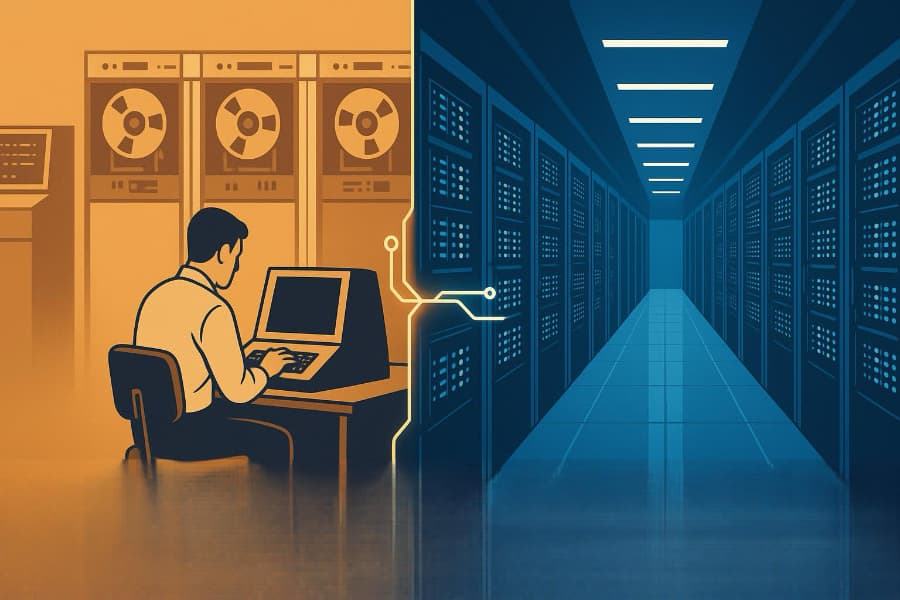
Before every company had a server room, before the cloud, before the laptop on your desk had more compute power than an entire city block once had, everyone depended on rented mainframe cycles. They cost millions of dollars just to keep the lights on and unless you are in the financial, airline or insurance industries you probably haven’t seen one in years.
Most businesses couldn’t afford one. So they rented time on somebody else’s.
Companies like Tymshare, CompuServe (long before it was an internet provider), and GE’s computing division built empires around this model. You’d dial in from a teletype terminal, run your payroll or your actuarial tables or your inventory reports, and then you’d get a bill. By the CPU second. By the connect minute. Sometimes by the character printed.
Inside large organizations, entire accounting departments existed (and still do in some companies) just to track “chargeback” — which department used how many compute units, and what they owed the central IT department. People argued over cycle budgets the same way people argue over cloud spend today.
Sound familiar?
Fast Forward to Tokens
Today, when you use an AI assistant — whether it’s Claude, ChatGPT, Gemini, or any of the others — you’re paying for tokens. Tokens are roughly chunks of text, somewhere between a syllable and a word, that the model processes on the way in and generates on the way out.
You’re renting inference cycles on someone else’s GPU cluster. The billing model is different. The underlying concept is identical.
And just like those early time-sharing bureaus, the companies running the infrastructure are betting that enough people will rent enough cycles to justify the staggering capital investment behind the curtain. The math is the same. Only the zeros have more zeros.
The Price Will Come Down
Here’s the part that should make you feel better.
In 1965, a minute of mainframe CPU time could cost what would be hundreds of dollars today. By the mid-80s, minicomputers had undercut the bureaus. By the 90s, a PC on every desk had made the whole model feel quaint. The compute didn’t go away — it just got so cheap it became invisible.
AI token prices are already following the same curve. What cost $60 per million tokens in early 2023 costs a fraction of that today, and competition is accelerating the drop. In five years, the idea that we once carefully budgeted AI usage the way we all once budgeted mainframe time will probably seem just as quaint. Even mainframes have become more affordable. Still not cheap by any means, but more affordable than they were in the 60’s, 70’s and 80’s.
This is how it always goes with transformative compute. It starts expensive, it gets rationalized, then it gets commoditized, and then it just becomes part of the cost of doing business —like electricity.
What the “Mainframers” Already Know
The people who navigated the shared mainframe era successfully weren’t the ones who refused to use shared compute because it was expensive. They were the ones who figured out which workloads were worth the cost right now, and which ones could wait for the price to drop.
That’s still good advice.
If a task genuinely benefits from AI — summarizing dense technical documents, drafting proposals, analyzing data, generating code scaffolding — the token cost is probably trivial compared to the man hours it usually takes to do the same tasks. If you’re using it to answer questions you could Google in thirty seconds, maybe reconsider.
Be strategic, not scared.
The Wheel Keeps Turning
There’s something reassuring about realizing that the thing everyone is breathlessly calling “unprecedented” has a pretty clear historical precedent. We’ve been here. We figured it out. We’ll figure it out again.
The mainframe time-sharing bureaus of the 1960s weren’t a detour in computing history. They were the first chapter of the story we’re still writing — the story of how transformative compute starts expensive, exclusive, and centralized, and ends up cheap, ubiquitous, and invisible.
We’re somewhere in the beginning chapters right now. It’s a good place to be paying attention.
Going back to my conversation with Claude, it answered my original statement with a sarcastic tone it had learned from me, “In the meantime, I’ll try to be worth the invoice.”
— Dale Sides is Managing Partner and co-founder of StoneCreekTechnologies, a multi-vendor enterprise IT solutions provider based in Marietta, GA. stonecreekit.com | 470-359-4567

.png)